282 results

ICTJ is outraged by the recent massacre in Syria, where over 1,000 civilians were brutally killed in yet another wave of violence. This appalling crime underscores the urgent and undeniable need to protect civilians and provide justice and accountability.

The fall of the Assad regime marks the beginning of a long-overdue transformation in Syria. For the first time in decades, space has opened to speak freely about justice, accountability, and reconciliation. It is a moment filled with uncertainty and pain, but also one of immense hope.

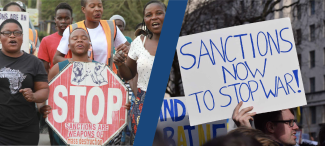
As a tool of foreign policy, sanctions have historically been deployed by one or more states to coerce a change of behavior or policy. In recent years, however, states have increasingly imposed sanctions on actors responsible for human rights violations, which has expanded their potential to advance transitional justice goals. Now, ICTJ is releasing a new report that considers this potential as well as the obstacles to justice sanctions may engender.

This report provides an analysis of international economic sanctions from a transitional justice perspective. It considers the role that sanctions may play in advancing or hindering accountability, redress, and prevention in response to massive and serious human rights violations. The...

in two different photos, people hold signs for and against sanctions

South Sudan’s transition to democratic governance through a highly anticipated, first-ever post-independence general election has to wait once again for another two years. Despite this latest extension, the country has achieved notable milestones in its transitional justice process.

As part of the new digital campaign "Reparations Build Justice," the ICTJ team would like to share the keynote address given by ICTJ Director of Programs and Deputy Executive Director Anna Myriam Roccatello at a recent conference on issues related to providing reparations through international criminal courts. In her remarks, Roccatello describes the inextricable link between accountability and reparation as well as ICTJ’s unwavering commitment to victims of massive human rights abuses.

The fall of Bashar al-Assad’s regime after 53 years of authoritarian rule marks a significant moment in the pursuit of justice, peace, and human rights. While this transition opens the door to new possibilities, it also underscores the immense obstacles and responsibilities that lie ahead.

ICTJ accompanied more than 10 Sudanese victim stakeholders to the International Criminal Court (ICC) in The Hague to attend the closing statements in the case of The Prosecutor v. Ali Muhammad Ali Abd-Al-Rahman ("Ali Kushayb"). The statements took place on December 11 to 13. ICTJ supported the ICC in the selection of the stakeholders, who were chosen for their strong ties with affected communities.

Customary justice is the primary way in which most communities in South Sudan resolve disputes. Its ability, however, to deal with massive human rights violations is limited due to the complexity of intercommunal violence and a lack of clarity on its proper role. This report contends ...

A man stands facing a table around which several men are seated.

In countries where state institutions have limited reach, customary and informal justice is often the most common way in which people resolve disputes and seek justice. Given its prominence, it is considered to be an important element of a people-centered approach to building peaceful, just, and inclusive societies. An understanding of the relationship between customary justice and transitional justice, however, remains underdeveloped. A new ICTJ report provides valuable empirical, qualitative research on the topic, in the context of South Sudan.